
Kvareli is in the centre of the Kakheti wine-producing region, and the town itself is known for its Kindzmarauli wine, a semi-sweet red variety. The town itself is very small with virtually nothing in the way of shops (there is a supermarket). We found only 1 other restaurant, other than our hotel
Chateau Kvareli

A relatively new hotel, not really a chateau, but it is owned by one of the big wine producers in the area. They have a neighbouring wine shop and tasting facility that guests can access free of charge.
The hotel is in the centre of the small town, but the town does not offer much else in the way of eating places. The hotel in fact has three restaurants - we chose to eat outside on the front of the hotel, which was the most popular place for locals, and enjoyed dinner
Breakfast was a buffet served in a bleak, windowless room below ground. It only offered 4 tables, each seating up to 10 people. I think we should have asked for a tray and carried our food up to the ground floor and eaten outside
The staff were very helpful (unusual for Georgia) One of the waitresses showed us round the wine production and helped us choose dinner.
The hotel has a deserved good reputation. We had a large corner room on the top floor. It was spacious and bright with a large balcony
Evenings can be chilly here and you need to dig the blankets out of the wardrobe, where they are well hidden
A word of warning about the local dogs. For reasons unclear to me, hotel staff feed the (presumably stray) dogs. This results in a pack of 6 or 7 dogs in permanent attendance. They bark all night, and if you opt to eat in the Beer Garden restaurant, you will be plagued by them.
Click on any of the thumbnails to get a bigger version of the picture
 |
 |
 |
 |
 |
 |
JSC Corporation Kindzmarauli
They were the owners of our hotel, Chateau Kvareli, the winery and the tasting facility. The enterprise owns approximately 150 hectares of vineyards, of which 100 hectares are in the historic Kindzmarauli micro zone. Every year they produce 25 different varieties of wine and about 10 wine brandies (Koniaks) using grapes harvested from their vineyards, as well as from local farmers.
We wandered round the town, but found little other than the local church. Then we had a wine tasting in the company nearby shop - included in the price of your hotel room. They have a penchant for semi-sweet red in Georgia, not my favourite wine, but quite distinctive and of a very reasonable quality. The boys insisted that I buy a bottle for later consumption. (well there was a small half bottle of Georgian brandy as well that later caused the Armenian border guard to question its provenance)
Click on any of the thumbnails to get a bigger version of the picture
 |
 |
 |
 |
 |
 |
 |
 |
 |
 |
Gremi
Gremi is a 16th-century architectural monument – the royal citadel and the Church of the Archangels – in Kakheti, Georgia. The complex is what has survived from the once flourishing town of Gremi and is located southwest of the present-day village of the same name in the Kvareli district.
Gremi was the capital of the Kingdom of Kakheti in the 16th and 17th centuries. Founded by Levan of Kakheti, it functioned as a lively trading town on the Silk Road and royal residence until being razed to the ground by the armies of Shah Abbas I of Persia in 1615. The town never regained its past prosperity and the kings of Kakheti transferred their capital to Telavi in the mid-17th century.
There was big Armenian population. The Russian diplomat Fedor Volkonsky, who was here in the 17th century, said: "Armenians have own church and market behind one was other church". He also said there were about 10 Armenian churches near the palace of king. The town appears to have occupied the area of approximately 40 hectares and to have been composed of three principal parts – the Archangels’ Church complex, the royal residence and the commercial neighbourhood. Since 2007, the monuments of Gremi have been proposed for inclusion into the UNESCO World Heritage Sites.
There was a church service when we were there, and although we saw inside the church, we did not see the museum (which was down to our guide scungy George)

Click on any of the thumbnails to get a bigger version of the picture
 |
 |
 |
 |
 |
 |
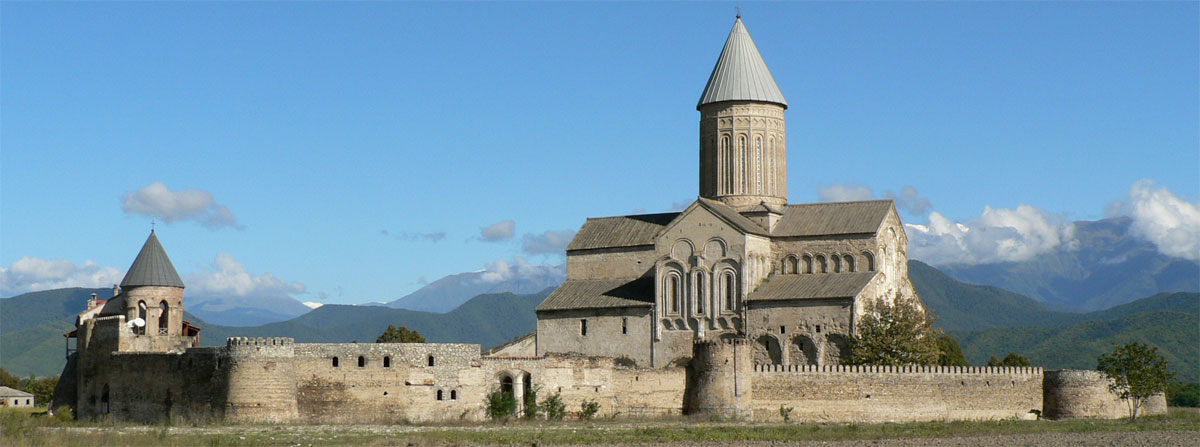
Alaverdi Cathedral, near Telavi
Alaverdi Monastery is a Georgian Eastern Orthodox monastery located 25 km from Akhmeta, in Eastern Georgia. While parts of the monastery date back to 6th century, the present day cathedral was built in the 11th century by Kvirike III of Kakheti, replacing an older church of St. George. It is also on the list for possible UNESCO inclusion
The monastery was founded by the Assyrian monk Joseph Alaverdeli, who came from Antioch and settled in Alaverdi, then a small village and former pagan religious centre dedicated to the Moon. At a height of over 55 m Alaverdi Cathedral was the tallest religious building in Georgia, until the construction of the Holy Trinity Cathedral of Tbilisi in 2004. The monastery is the focus of the annual religious celebration Alaverdoba. Situated in the heart of the world's oldest wine region, the monks also make their own wine, known as Alaverdi Monastery Cellar
.
Click on any of the thumbnails to get a bigger version of the picture
 |
 |
 |
 |
 |
 |
 |
 |
Qvevri wine production
We went to what looked like just a house in the country, but the owner was hard at work making large clay pots called qvevri, in which Georgians traditionally make wine. Each pot is hand made and fired in small batches. They are now exporting them to other countries
After the hand-made terracotta coil pots have been fired and painted inside with beeswax, they’re usually given an external wire armature to prevent cracking when full of liquid, and an external coating of powdered lime with cement or sand for strength and as a disinfectant. The qvevri are buried up to their necks in sand and gravel to facilitate the passage of air and absorb any shocks from the ground. A Georgian cellar contains buried qvevri of varying sizes to accommodate different volumes of wine.
At harvest time the grapes are crushed – either by foot or now more usually using a hand or mechanical crusher – and pumped or allowed to fall by gravity into a clean qvevri.The winemakers who grow their vines without herbicides and pesticides rely on wild or spontaneous yeasts that live in the grape skins to trigger the first, or alcoholic, fermentation. No ‘selected’ or factory-produced yeasts or other chemical ‘correctors’ are used. Sometimes a tiny amount of sulphite to ward off bacteria may be added, but it’s far less than is common in ‘conventional’ wine making. Many avoid it altogether.
During fermentation, the cap is punched back down into the must using a long pole with sticks running crosswise through its end. The secondary, or malolactic, fermentation follows the first as the wine’s tart, malic acids (as in apples) are converted to softer-tasting, lactic acid (as in milk).
When the fermentation has run its course, the solids drop naturally into the qvevri’s pointed bottom. Red wines may be removed from their solids soon after this, while white wines are usually given the short or extended skin contact that characterizes the so-called orange wines. Macerated qvevri wines offer a range of colours.
When the fermentation is complete, the qvevri’s top is sealed, though a tiny amount of oxygen still enters through the clay pores. The wine may be separated from the skins very quickly, or remain on them for several months, extracting tannins, phenols, flavour and anthocyanins from them as it goes.
If long-macerated Kakhetian wines tend to be robust in their colour and tannins, west-Georgian wines are often very fresh, paler in hue and lower in alcohol thanks to spending much less, if any, time on the skins. The wines are pumped out of the qvevri when the winemaker decides to take them off the lees (in the old days, a dried-gourd scoop was used) and either bottled and sold, or moved to a clean qvevri to continue the ageing. There are no barrels or vats in a traditional qvevri cellar.
Click on any of the thumbnails to get a bigger version of the picture
 |
 |
 |
 |
 |
 |
 |
 |
 |
 |
Telavi Alexander Chavchavadze Museum
Prince Alexander Chavchavadze (1786 – November 6, 1846) was a notable Georgian poet, public benefactor and military figure. Regarded as the "father of Georgian romanticism", he was a pre-eminent Georgian aristocrat and a talented general in the Imperial Russian service.
The history of the Chavchavadze family and their ancestral estate is closely tied with the history of Georgia. Today this museum, in Tsinandali, is visited by tourists from all over the world. The interior of the 19h century has almost been fully restored, though the palace today only has 7 rooms of the original 20. It was also possible to collect touching material evidences from the relatives of the bygone period: embroideries made by the daughters of Chavchavadze, books owned by the family, clothing, and the picture of Imam Shamil painted by Anna when she was held in captivity. The museum has the working desk of Alexander Chavchavadze, the first grand piano, and personal things and books. There are regular art exhibitions held in the museum, and the basement of the palace hosts Kakhetian wine tasting ceremonies.
The museum itself will be most meaningful to Russian and Georgian speakers familiar with the work of Chavchavadze, since the collection is almost exclusively devoted to his memorabilia and that of his family. In addition the rooms show what the good life in Kakheti must have been like in the 19th century.
Click on any of the thumbnails to get a bigger version of the picture
 |
 |
 |
 |
 |
 |
 |
 |
 |
 |
Back to Tbilisi and then